Target Barcode Requirements for Suppliers: What You Actually Need (2026)
Target's barcode requirements go a layer deeper than Amazon or Walmart's, and a lot of new suppliers only discover the gap after a shipment gets hit with a labeling chargeback. Here's what Target actually expects at each level, in plain terms.
Target's barcode requirements go a layer deeper than Amazon or Walmart's, and a lot of new suppliers only discover the gap after a shipment gets hit with a labeling chargeback. Here's what Target actually expects at each level, in plain terms.
Item-Level: A Standard UPC-A on the Product Itself
At the individual product level, Target uses the same standard as most major retailers: a GS1-issued UPC-A barcode on the item's packaging. This is the barcode consumers see and cashiers scan at checkout, and it works the same way it does for Amazon, Walmart, or any other retailer — one unique UPC per product/variant, issued through GS1.
Case-Level: Where Target Gets More Flexible (and More Specific)
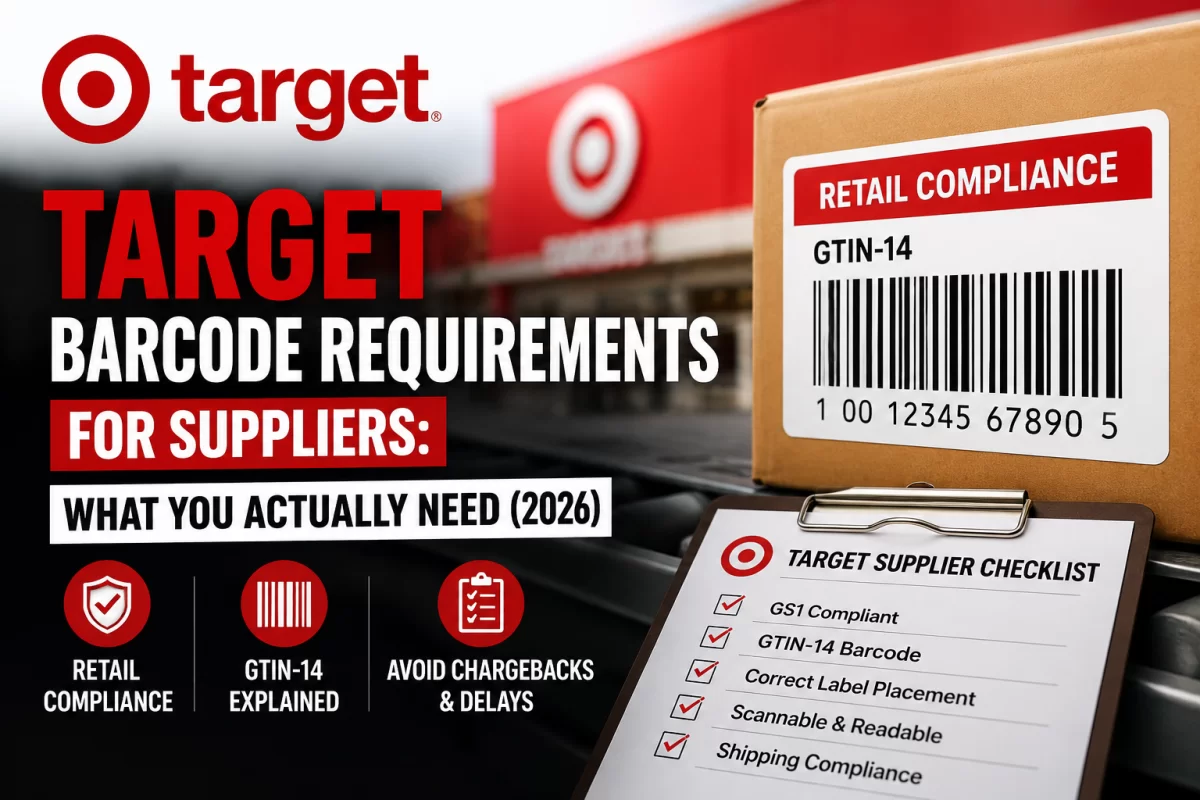
Where Target differs from many retailers is at the shipping-carton level. Instead of mandating a single case-label format, Target offers suppliers a choice between three barcode types: SSCC-18 (a unique shipping container code), GTIN-14 (identifies a case or inner pack — e.g. "this carton contains 12 units of Product X" without anyone opening it), or UPC-A reused at the case level. Whichever format you choose, Target requires consistency — you can't mix formats across shipments once you've established your labeling approach.
Do You Need Your Own GS1 Company Prefix to Sell to Target?
This is the part that trips up a lot of suppliers coming from marketplace selling. For a single product's item-level UPC, a GS1-certified barcode purchased individually generally covers what's needed. But once you're operating as a registered Target vendor generating your own ongoing case-level codes (GTIN-14, SSCC-18) across a growing catalog, most suppliers end up needing their own GS1 Company Prefix rather than one-off purchases — Target's formal vendor relationship and EDI system are built around a supplier managing its own numbering range over time, not a single transaction. If you're at the stage of evaluating your first Target listing, it's worth reading up on what a Company Prefix actually involves before assuming a single barcode purchase will carry you through the full vendor relationship.
Target's Label Approval Process
- Before your first shipment, Target requires a formal label approval step — you submit sample labels for review and sign-off through their vendor portal before shipping live inventory.
- Barcodes on cartons and products must scan cleanly at receiving; defective or unscannable barcodes can trigger a per-carton chargeback.
- Label placement follows Target's standard positioning rules, including specific handling for smaller cartons.
- All of this runs through Target's vendor portal, which also tracks broader compliance metrics beyond just barcodes — on-time delivery, shipment accuracy, and more.
Common Mistakes That Cause Target Chargebacks
- Mixing case-label formats (e.g. GTIN-14 on some shipments, SSCC-18 on others) instead of picking one and staying consistent.
- Skipping the label pre-approval step and shipping without formal sign-off.
- Reusing a single UPC across different product variants at the item level.
- Printing barcodes too small or on reflective packaging, causing scan failures at receiving.
Frequently Asked Questions
Is Target's item-level barcode different from what Amazon requires?
No — at the individual product level, both expect a standard GS1-issued UPC-A. The difference shows up at the case/shipping level, which Target handles with more format flexibility and formal process than most marketplaces.
Can I use the same UPC I already use for Amazon or Walmart on Target?
Yes. A GS1-issued UPC is a universal, product-level identifier — the same number is valid across every retailer, since it identifies the product, not the sales channel.
What happens if my carton barcode doesn't scan at Target's receiving dock?
It can trigger a compliance chargeback and delay processing of that shipment, which is why Target's pre-shipment label approval step exists — to catch scanning issues before they become chargebacks.
Do small or new suppliers really need a full GS1 Company Prefix for Target?
It depends on scale and how long you plan to supply Target. A single item-level UPC can be purchased individually to get started, but an ongoing Target vendor relationship generating case-level codes across a growing catalog is generally better served by holding your own Company Prefix.
Ready to get your barcode? Buy GS1-certified barcodes here →